
Here's something that happened at my daughter's 9-month checkup that I still think about.
The pediatrician asked me what her weight was at 6 months. I said, "around 7 kg, I think." She asked what it was at birth. I said, "3.1 kg — that one I remember." She asked what it was at 3 months. I went blank.
She was kind about it. But she needed those numbers to plot a growth curve and check that my daughter was gaining weight at a healthy rate. Without consistent measurements, she was working blind. And so was I.
According to the WHO Child Growth Standards, consistent weight and height tracking from birth is one of the most reliable early indicators of a child's nutritional status and overall health. In India, where 35.5% of children under 5 are still stunted due to chronic undernutrition (NFHS-5, 2021), catching growth problems early is genuinely life-changing — not just helpful. A Baby growth tracker App for Android and iPhone is the simplest tool most parents aren't using but absolutely should be.
Here are 10 real benefits — not marketing fluff, actual reasons it matters.
What Is a Baby Growth Tracker App, Actually?
Before we get into the benefits, let me explain what one of these apps does in plain terms.
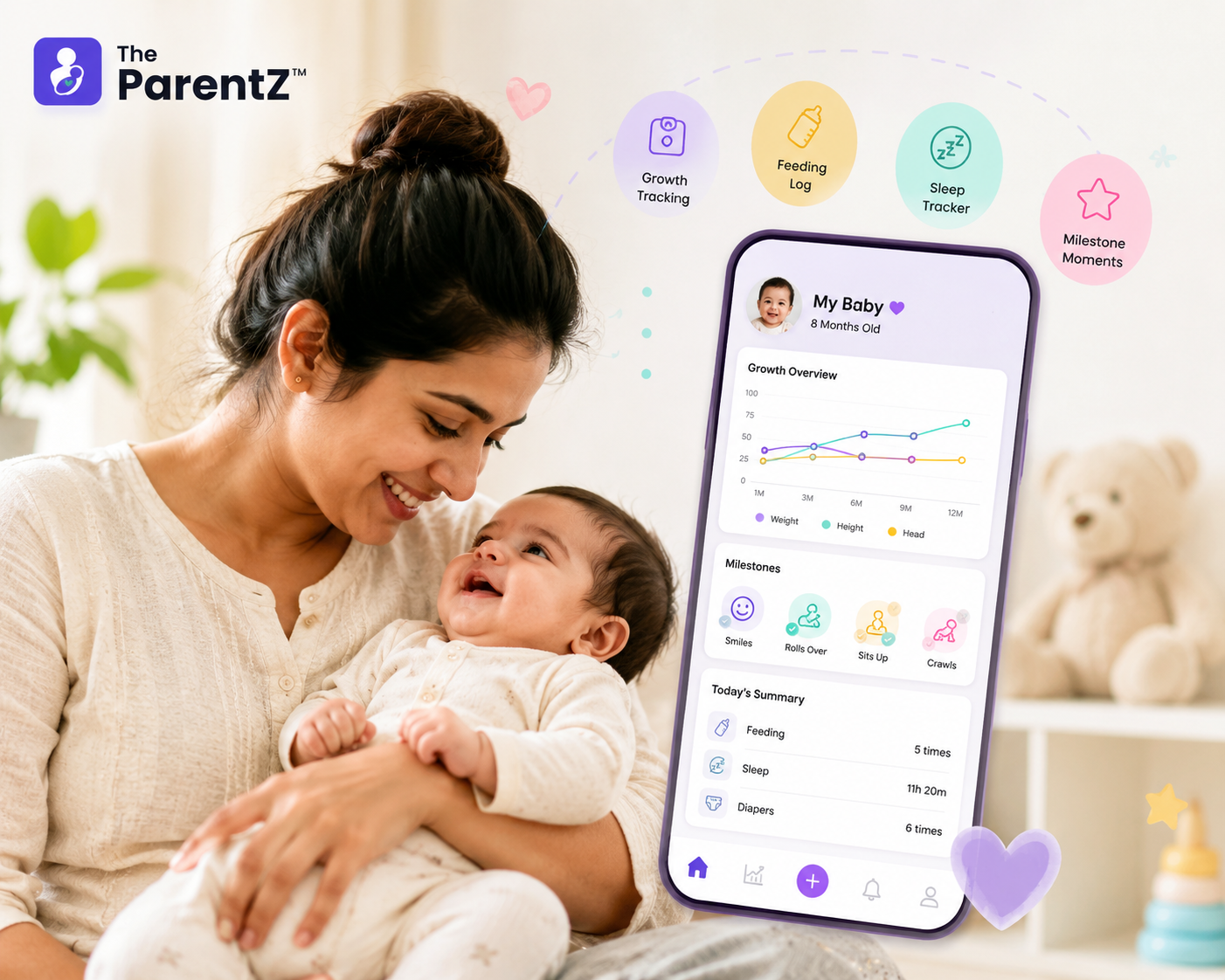
You enter your baby's weight, height, and head circumference after each measurement — whether that's at a clinic visit or at home with a weighing scale. The app plots these on a growth chart (usually WHO or Indian Academy of Pediatrics standards) and shows you where your baby falls compared to other children the same age.
That's the core. Good apps also let you log measurements over time, track trends, flag if something looks unusually slow, and generate a report you can share with your doctor.
Think of it like a school report card — except instead of grades, it shows kilograms and centimeters, and instead of yearly, it updates every few weeks.
Benefit 1: You Always Have the Numbers Your Doctor Needs
Every pediatric visit in India starts with measurements. Weight, height, and sometimes head circumference. The doctor plots these against a growth chart and checks whether your baby is on track.
The problem is that most parents only have the measurements from the clinic visits — and only if the clinic recorded them in the health card, which doesn't always happen consistently.
A growth tracker app gives you a complete record. You add measurements from every visit, plus any time you measure at home. When the doctor asks, "What was her weight last month?" — you have the answer in three seconds, not a rough memory.
Benefit 2: You Can See the Trend, Not Just the Number
This is the benefit most parents miss, and it's actually the most important one.
A single weight measurement doesn't tell you much. 7.2 kg at 9 months could be perfectly fine or a concern — it depends entirely on whether your baby was 6.8 kg at 8 months (good gain) or 7.1 kg at 7 months (very slow gain over two months).
The trend is the story. A growth tracker shows you that trend visually — a line moving up on a chart. When the line flattens, something is worth investigating. When it curves upward, you know the feeding changes you made are working.
A single number without context is like getting one stock price and calling it an investment strategy.
Benefit 3: You Stop Comparing Your Baby to the Neighbor's Baby
Every Indian parent has experienced this. Someone in the family says, "Sharma ji ke bache ko dekho — kitna healthy hai" (Look at Sharma's child — so healthy). Your baby looks smaller. You start worrying.
Here's the thing — healthy babies come in genuinely different sizes. A baby consistently tracking at the 25th percentile is not less healthy than one at the 75th, as long as their own curve is moving steadily upward.
When you have a growth chart in your app, you can show your family (and reassure yourself) that your baby is following their own healthy curve. The comparison is against your baby's own progress — not against the neighbor's child, who may simply have different genetics.
Benefit 4: Early Warning for Growth Concerns
This is the one benefit that can genuinely change outcomes.
Pediatricians watch for something called "faltering growth" — when a baby's weight gain slows significantly or stops for a period. Caught early, it's usually addressable: feeding adjustments, checking for latent illness, dietary changes. Caught late, it can lead to lasting developmental effects.
A growth tracker app that plots your baby on a WHO percentile chart will visually flag when the curve starts to flatten. You're not diagnosing anything — you're noticing a pattern that's worth raising with your doctor at the next visit, or calling about sooner.
Most parents who catch this early say the same thing: "I wouldn't have noticed if I hadn't been logging regularly."
Benefit 5: It Works on Both Android and iPhone — No Compatibility Drama
This matters more than it sounds in Indian households.
It's common for one parent to use an Android (often the more affordable option) and the other to have an iPhone. Or for the grandmother to have a basic Android and the mother to be on iOS. If the app only works on one platform, half the family is excluded from accessing the records.
A well-built baby growth tracker that runs properly on both Android and iPhone means everyone involved in the baby's care can see the same data. No "send me a screenshot" back and forth. No outdated numbers floating around on different devices.
Benefit 6: You Can Track Multiple Children Without Starting Over
If you have more than one child — or when you have a second baby — you don't want to start from scratch in a new app or a new notebook.
Good growth tracker apps let you create separate profiles for each child under one account. You can switch between them easily. The older child's complete growth history stays intact while you start logging the new baby's measurements.
For families in India where two or three children of close age are common, this matters practically. One app, one account, multiple records — all accessible from the same phone.
Benefit 7: It Replaces the Health Card That Always Gets Lost
Every hospital in India gives you a child health card at birth — a small booklet where measurements get recorded at each visit. It's a decent system until the card gets lost, left at home during an emergency visit, or so scribbled on by different nurses that the numbers are illegible.
I've heard of children arriving at new clinics — after a family relocation — with no readable growth history at all. The new pediatrician has to start from scratch.
A digital record on your phone doesn't get lost. It doesn't get rained on. It travels with you to Bangalore or to the in-laws' house in Jaipur. And it can be exported as a clean PDF when a new doctor needs the full history.
Benefit 8: It Helps You See How Feeding Changes Affect Growth
This is a benefit I didn't expect, but ended up using a lot.
When I switched my daughter from exclusive breastfeeding to mixed feeding at around 5 months (on pediatric advice), I was anxious about whether the change was affecting her growth positively or negatively.
Because I was logging weight every 2 weeks, I could actually see what happened: her weight gain rate stayed steady through the transition. That was genuinely reassuring. I wasn't guessing — I had data.
The same applies when starting solids. When you introduce foods at 6 months and start logging weight monthly, you can see whether growth is responding well or whether something in the diet needs adjustment.
Benefit 9: The Charts Use WHO Standards — Not Random Averages
This sounds technical, but it's worth understanding.
Not all "growth charts" are the same. Some older apps use US CDC charts, which are based on a mix of feeding types and may not reflect optimal growth for exclusively breastfed babies. Some apps use outdated Indian data.
The WHO Child Growth Standards (published in 2006) were developed across multiple countries, including India, and represent how children grow under optimal conditions — regardless of feeding method. A growth tracker that uses WHO standards gives you the most globally accepted benchmark.
The Parentz uses WHO-aligned growth charts, which means what you're seeing is consistent with what your IAP-trained pediatrician in India is also working from.
Benefit 10: Looking Back at the Chart Feels Like Watching Your Baby Grow Again
Okay, this one is less medical and more human. But it's real.
When my daughter turned one, I scrolled back through 12 months of growth data on the app. I saw the small dip in weight gain around month 3 when she had a cold. I saw the jump after we started solids. I saw the slow, steady climb from 3.1 kg at birth to 9.4 kg at one year.
It told a story. Her story. In a way that photos don't, because photos show you the moments, but the growth chart shows you the arc.
What Works and What Usually Fails With Growth Tracker Apps
What works well:
Logging measurements right after the clinic visit, while you're still in the waiting area or sitting in the car. The number is fresh, the app is right there, and it takes 30 seconds. Do it then. Not tonight.
Using the WHO percentile view to understand where your baby sits relative to peers. This is far more useful than raw numbers for most parents.
What usually fails:
Measuring at home with a basic household scale and expecting clinic-level accuracy. Home scales are useful for tracking direction — gaining or not gaining — but the numbers can vary by 200–300 grams depending on the scale, time of day, and whether the baby has just been fed. Note measurements as "home" versus "clinic" in the app so you're comparing like with like.
Logging sporadically for three months and then stopping. The value of growth tracking compounds over time. A record of 6 consistent data points tells a richer story than 20 measurements bunched in the first two months and nothing after.
My honest take on this: Most parents track weight fairly well, but consistently skip head circumference because it feels awkward to measure at home. This is a shame — head circumference is one of the earliest indicators of neurological development issues. If your clinic measures it, log it every time. It takes one extra second in the app.
App vs. Paper Health Card: Side-by-Side Comparison

The paper card isn't useless — but it's passive. It records what happened. The app shows you what it means.
How to Get Started: A Simple 4-Step Setup
Step 1: Download and create your baby's profile. Name, date of birth, gender, birth weight. The app uses birth weight as the starting point for your growth chart.
Step 2: Enter any past measurements you have. Dig out the health card, or call the clinic if needed. Even three or four past data points are better than starting from zero.
Step 3: Log measurements after every clinic visit going forward. Set a reminder in your phone for the day after each scheduled visit — when you'll have fresh numbers to enter.
Step 4: Review the chart before your next pediatric appointment. Look at the trend. Note anything that seems flat or unexpected. Bring those observations to your doctor — it makes the appointment more productive.
Frequently Asked Questions
How often should I measure my baby's weight at home?
For most healthy babies, monthly measurements between clinic visits are enough. More frequent measurement can sometimes increase parental anxiety without adding meaningful data. If your doctor has flagged a concern, they'll advise more frequent checks.
My baby is at the 10th percentile. Should I be worried?
Not necessarily. The 10th percentile means roughly 10% of babies weigh less and 90% weigh more — but it's a normal part of the distribution, not a warning sign on its own. What matters is whether your baby is consistently tracking along their own curve. A sustained drop across percentile lines is more concerning than a low but stable position.
Can I use the app without internet access?
The Parentz works with core features offline, which matters in parts of India where connectivity is inconsistent. Data syncs when you're back online.
My baby was premature. Do standard growth charts apply?
Premature babies are usually tracked on adjusted age (corrected for how early they were born) until around 2 years old. Good apps allow you to enter a corrected age so the chart reflects an accurate developmental comparison. Check that the app supports this if your baby was born early.
Does the app only track weight, or height and head circumference too?
The Parentz tracks all three — weight, length/height, and head circumference — which gives you the complete picture your pediatrician needs.
Is the data backed up if I change phones?
Yes, as long as you're logged into your account, your baby's growth history syncs to the cloud and carries over when you switch devices. No starting over.
Final Thoughts: Numbers That Actually Mean Something
Here's the honest version of why I think every Indian parent should use a baby growth tracker app.
It's not because the app is magical. It's because the alternative — keeping numbers in your head, relying on a paper card, or just trusting that everything looks fine — leaves gaps that matter.
India has made enormous progress in child health outcomes over the past two decades. But malnutrition and growth faltering are still widespread, and they're still most often caught late because nobody was tracking consistently.
You can't fix what you can't see. A growth chart shows you the story of your child's development in a way that nothing else does — not photos, not memory, not even the pediatrician's reassurance at a single visit.
The Parentz makes that tracking effortless, consistent, and actually useful — because it ties the growth data to the rest of your baby's health record. Vaccinations, milestones, feeding logs — all in one place, all telling the same story about how your child is growing.
That's not a parenting hack. That's just good information, in your hands, when you need it.
Key Takeaways
WHO standards say consistent weight and height tracking from birth is one of the best early indicators of child health — yet most Indian parents only have patchy records
The trend over time matters far more than any single measurement — a growth tracker shows you the curve, not just a number
35.5% of Indian children under 5 are stunted due to undernutrition (NFHS-5) — early growth tracking is one of the most practical ways parents can catch and address this
Head circumference is the most commonly skipped measurement — log it every time your clinic records it
Don't mix home scale measurements with clinic measurements in the same trend analysis without labeling them separately
The Parentz works on both Android and iPhone, supports multiple child profiles, uses WHO growth standards, and integrates with vaccination and milestone tracking in one place
Start logging from birth measurements, not from today — even partial historical data makes your growth chart far more useful








Write a comment ...