
Let me be honest with you. When my sister had her first baby, she spent the first three months convinced something was wrong. The baby was eating, sleeping, peeing — all the right things. But she had no real way to know if the growth was on track. She'd weigh the baby on a kitchen scale, scribble a number on a Post-it, and then forget where she put it. Sound familiar?
Here's the thing. India has one of the highest rates of child undernutrition in the world. According to NFHS-5 data, 35.5% of children under five are stunted — meaning their growth has been affected, often without parents realizing it early enough. That's not a scare tactic. That's just the reality of why tracking matters. And that's exactly what a good child health and growth tracker App is built to fix. This post covers the growth worries most Indian parents actually have, what usually helps, what rarely does, and where a Baby Growth Tracker App for Android and iPhone fits into all of it.
So What Even Counts as "Normal" Growth?
This is where most parents get tripped up — and honestly, it's not their fault.
Nobody tells you clearly that "normal" is a range, not a number. Your pediatrician checks a percentile chart, but explains what those percentiles actually mean. That part often gets skipped because the appointment is only 10 minutes long.
Here's the simple version. If your baby is in the 30th percentile for weight, that just means 70% of babies their age weigh more. It does not mean your baby is underweight or unhealthy. What doctors actually watch for is whether your baby stays consistent on their own curve over time. A baby who drops from the 60th to the 20th percentile in two months — that's the alarm bell.
For detailed month-by-month numbers, the first year weight height chart with data breaks it all down clearly.
The Growth Concerns Indian Parents Actually Worry About
1. My baby isn't gaining weight fast enough.
This is, without question, the worry that wakes parents up at 2 AM, especially in the first three months.
Here's what's genuinely typical:

What usually works here: weighing your baby on the same scale, at the same time of day, every week. Consistency matters more than precision.
What often fails: comparing your baby to a neighbour's baby, or to a cousin's baby who "looks bigger." Babies have different genetic builds. That comparison will just stress you out for no reason.
2. My baby looks shorter than other babies
Height is the slowest metric to change. Parents often don't notice a stall in height because the difference week-to-week is tiny.
Rough milestones:
Birth: ~50 cm
3 months: ~60 cm
6 months: ~67 cm
12 months: ~74–76 cm
A consistent height stall — especially when combined with low weight gain — can sometimes point to Vitamin D deficiency, which is actually very common in Indian babies who aren't getting enough sunlight. Worth mentioning to your doctor if you see it.
3. My baby's head looks too big — or too small.
Most parents don't track head circumference at home. I'd argue they should, at least for six months.
The brain grows faster in the first year than it ever will again. Head circumference tracks that. A head growing too slowly can flag developmental concerns. One growing too fast can sometimes indicate fluid buildup. Your pediatrician measures this at every visit — but those visits are spaced out. Monthly home tracking fills the gap.
4. I'm breastfeeding and have no idea if my baby is getting enough milk.
This one is genuinely hard. You can't see how many millilitres your baby is consuming. There's no gauge on the side.
The two things that actually tell you if intake is okay: consistent weight gain and enough wet diapers (roughly 6 or more per day after the first week). That's it. Everything else — whether the baby seems satisfied, whether the breast feels "empty" — is guesswork.
A tracker app helps here because you can log diaper count and feeding sessions alongside weight. When you look at that data together, the picture becomes clearer.
5. My baby stopped gaining weight around the 12-month mark.
This happens more often than most parents expect. After the first birthday, babies' growth naturally slows — but sometimes it slows too much.
In India, this stage is tricky for a few specific reasons:
Many families start introducing heavy, spicy foods that babies' stomachs aren't quite ready for
Iron deficiency is common at this age, and it kills appetite
Babies are also starting to walk, getting more infections, and sleeping differently — all of which affect eating
Joint family setups mean the baby is sometimes fed by whoever is around, without consistency in portion or timing
None of this is a parenting failure. It's just reality. But it does mean that tracking between the 9-month and 18-month period is especially important.
6. My doctor says everything is fine, but something feels off.
Honestly? Trust that instinct. Go get a second opinion. And bring data with you.
This is where a tracker app earns its place the most. When you walk into a clinic with three months of weight, height, and feeding data on your phone, you're not just a worried parent anymore. You're a parent with evidence. Doctors take that seriously. It changes the quality of the conversation.
Why the Notebook System Almost Always Fails
I've seen parents try the notebook method. It works for about two weeks. Then the notebook is in a hospital bag, the pen is missing, and nobody can remember what the weight was last Tuesday.
The core problem with tracking by hand:
You write down the number, but not the time or date
You have no way to visualize a trend — numbers on paper don't show you a curve
You can't compare your data against WHO percentile charts without doing the math yourself
If your partner is also doing checkups, you're working from two different places
You miss patterns that only become visible over six to eight weeks
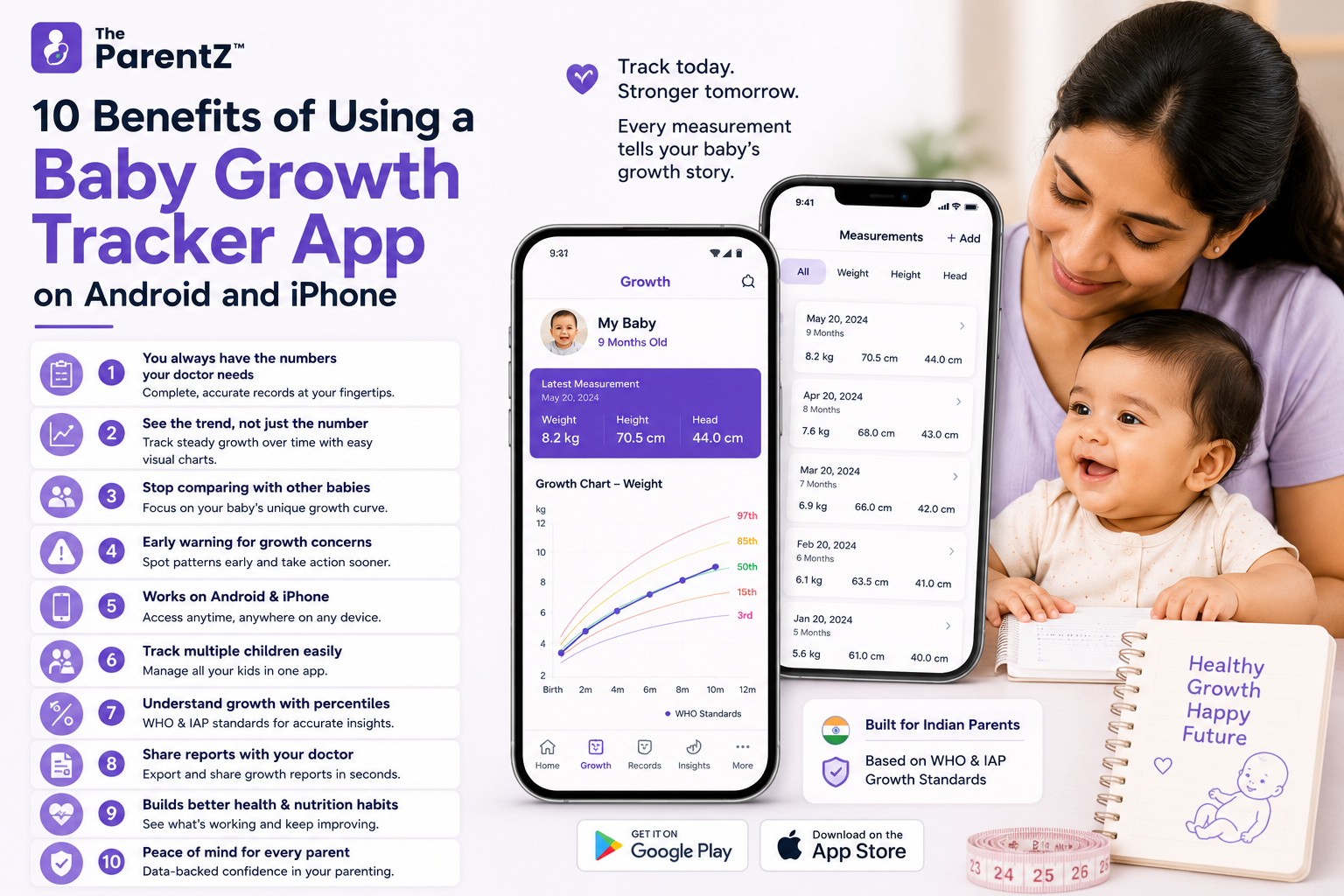
A Baby Growth Tracker App for Android and iPhone solves all of this. Not because apps are magic, but because they do the boring work automatically — plotting data on a chart, calculating percentiles, flagging deviations — so you don't have to.
What a Good Baby Growth Tracker App Actually Does
It shows you a growth curve, not just a number
This is the most important thing. A single weight reading means almost nothing in isolation. A curve over twelve weeks tells you everything. The app plots each measurement on a WHO-standard percentile chart so you can see the trend at a glance.
It catches problems before your next appointment
If your baby's weight hasn't budged in two weeks, the app can flag it. Without tracking, you might not notice until the 3-month checkup — and six or eight weeks is a long time when a baby is small.
It keeps everything in one place
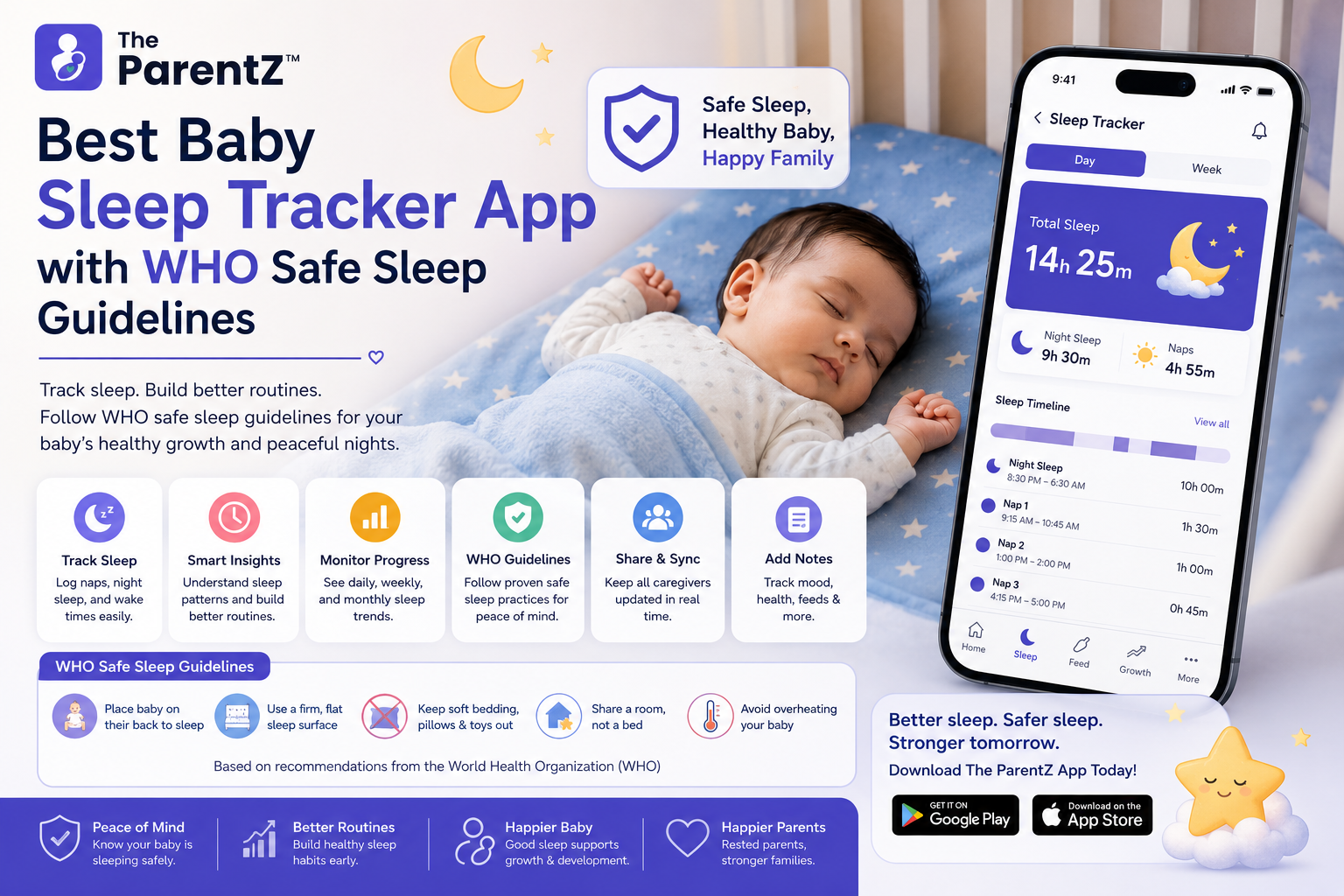
Weight. Height. Head size. Feeding logs. Diaper count. Vaccination dates. Sleep hours. Instead of scattered notes and half-remembered doctor advice, it's all on one screen.
It works across Android and iPhone
This matters more than you'd think. In most Indian households, one parent has a Samsung or OnePlus and the other has an iPhone. A Baby Growth Tracker App for Android and iPhone that syncs across both means either parent can log data, and both can see the same picture. Grandparents who help with childcare can also be added.
It makes your pediatric appointments more useful
Export a growth summary before your next checkup. Hand it to the doctor. Suddenly, you're not spending the first five minutes of the appointment trying to recall what your baby weighed last month.
App vs. Manual Tracking: What Actually Works Better

How to Actually Get Started (Without Overcomplicating It)
Step 1: Download The Parentz Baby Growth Tracker from Google Play (Android) or the App Store (iPhone).
Step 2: Create your baby's profile. You'll enter name, date of birth, gender, and birth measurements. These are your baselines.
Step 3: Log today's measurements — weight, height, and head circumference if you have them. The app charts them immediately.
Step 4: Set a weekly reminder. Pick a consistent day and time. Same day, same scale, same conditions every time.
Step 5: Start logging feeds and diapers. Takes 30 seconds. The value shows up after a few weeks, when you can see patterns.
Step 6: Before your next pediatrician visit, export the growth summary. Walk in with data instead of guesses.
That's it. You don't need to do all of this perfectly from day one. Even just tracking weight consistently gives you a huge advantage over tracking nothing at all.
Quick Reference: Indian Baby Growth Milestones, Year One
Indian babies may track slightly differently from global WHO averages because of genetic and dietary factors. The IAP (Indian Academy of Pediatrics) has its own growth standards — these numbers reflect both:

These are wide ranges on purpose. Your baby doesn't need to hit the middle of the range. They just need to grow consistently along their own trajectory.
FAQs
How often should I weigh my baby at home?
Once a week for the first three months. Every two weeks, for three to six months. Monthly, after that. More frequent than weekly actually creates more anxiety than information — tiny day-to-day fluctuations are meaningless.
Is it safe to store my baby's data in an app?
Check the app's privacy policy before signing up. Reputable apps use encrypted storage and don't sell your data. The Parentz follows standard data security practices.
My baby was born early. Do I use the regular growth chart?
No, you use the corrected age. If your baby was born 8 weeks early and is now 6 months old, compare them to a 4-month-old on the chart. Most good tracker apps have a prematurity adjustment option. If yours doesn't, that's a reason to look for a different one.
Can my husband and I both use the app together?
Yes. You can share access to the same baby's profile. Whoever is around for the measurement can log it. Both of you see the same data. This is actually one of the most underrated features — it stops the "I thought you wrote it down" situation.
My baby's weight dipped this week. Should I be worried?
Probably not, if it's just one week. Illness, a growth spurt, reducing appetite temporarily, or even just being weighed at a different time of day can shift the number. One data point is not a trend. Two or three weeks of no gain or loss — that's worth a call to your pediatrician.
Will the app tell me what's causing a growth problem?
No, and any app that claims to do that should be avoided. A tracker shows you what the data looks like. Your doctor figures out why. That's the right division of responsibility.
My Honest Take on All of This
Here's an opinion, not a marketing line: most parenting anxiety about baby growth comes from having no data, not from something actually being wrong.
Parents who track consistently tend to stress less. Not because everything is always fine, but because they know early when something isn't. That early knowledge — catching a two-week weight stall instead of a two-month one — is genuinely valuable. It leads to faster conversations with doctors and faster fixes.
Manual tracking usually fails within a month. That's not a criticism, it's just what happens when people are sleep-deprived and managing everything else that comes with a newborn. An app removes the friction. That matters.
At The Parentz, this is exactly what the platform is built for — giving Indian parents real tools, not just information. A Baby Growth Tracker App for Android and iPhone that plots real WHO and IAP data, keeps everything in one place, and actually helps you show up to your doctor's appointment prepared. That's the whole point.
If your baby was born today and you haven't started tracking yet, start now. The data from the first few weeks is the hardest to recreate later.
Key Takeaways
Normal growth is a range, not a fixed number — what matters is staying consistent on your baby's own curve
The six biggest concerns (weight, height, head size, feeding intake, post-12-month stalling, gut instinct) all get easier to manage with consistent tracking
Manual tracking with notebooks usually fails within a month — not because parents don't try, but because it's too easy to forget
A baby growth tracker App for Android and iPhone plots WHO/IAP percentile charts automatically and flags deviations before your next appointment
Indian babies have slightly different typical ranges — IAP growth charts are more relevant than global WHO averages alone
One bad week of weight is not a problem. A consistent downward trend over three to four weeks is worth a pediatrician call
Walking into a doctor's appointment with three months of tracked data changes the quality of that conversation








Write a comment ...